In shift, Israel quietly allows Jewish prayer on temple mount
The Israeli government has long forbidden Jews to pray on the Temple Mount, a site sacred to Jews and Muslims, yet Rabbi Yehudah Glick made little effort to hide his prayers. In fact, he was livestreaming them.
“Oh Lord!” Glick prayed, as he filmed himself on his phone on a recent morning. “Save my soul from false lips and deceitful tongues!”
Since Israel captured the Old City of Jerusalem from Jordan in 1967, it has maintained a fragile religious balance at the Temple Mount, the most divisive site in Jerusalem: Only Muslims can worship there, while Jews can pray at the Western Wall below.
But recently the government has quietly allowed increasing numbers of Jews to pray there, a shift that could aggravate the instability in East Jerusalem and potentially lead to religious conflict.
“It’s a sensitive place,” said Ehud Olmert, a former Israeli prime minister. “And sensitive places such as this, which have an enormous potential for explosion, need to be treated with care.”
Glick, an American-born, right-wing former lawmaker, has been leading efforts to change the status quo for decades. He characterizes his effort as a matter of religious freedom: If Muslims can pray there, why not Jews?
“God is the master of all humanity,” he said. “And he wants every one of us to be here to worship, everyone in his own style.”
But the prohibition of Jewish prayer on the 37-acre plateau that once held two ancient Jewish temples was part of a long-standing compromise to avoid conflict at a site that has been a frequent flashpoint between Israelis and Palestinians.
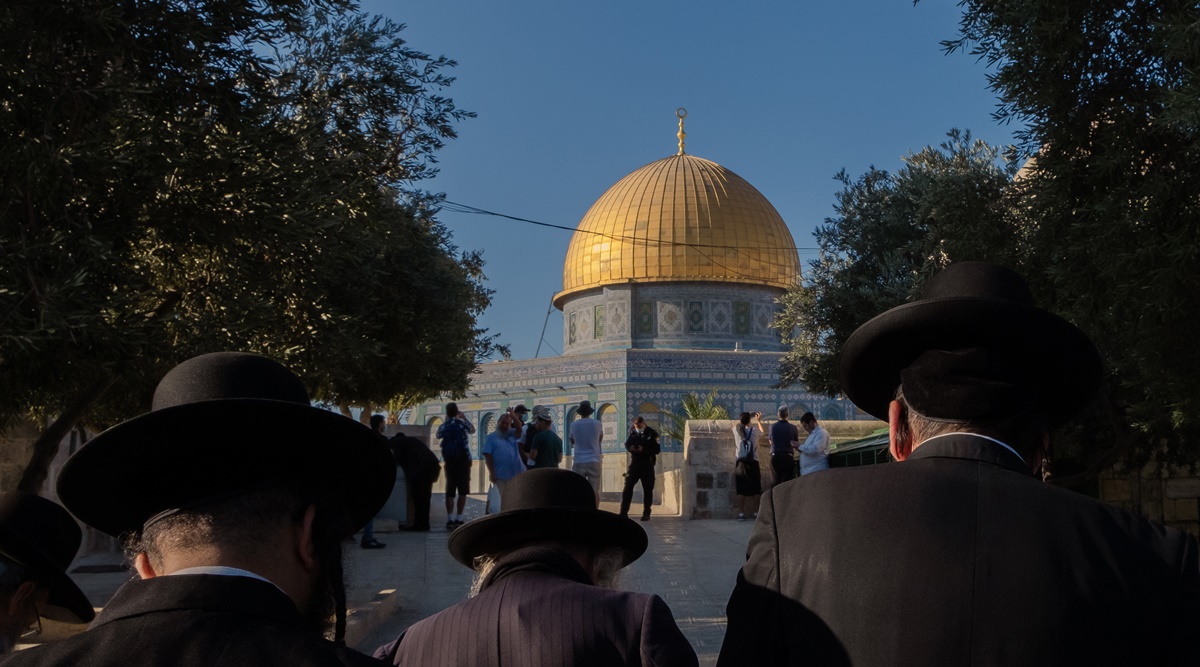
Under the arrangement, the Jordanian government has retained administrative oversight of the Temple Mount, known to Arabs as the Noble Sanctuary or Al-Aqsa compound. Al-Aqsa Mosque and the golden Dome of the Rock, a shrine that Muslim tradition considers to be the spot where the Prophet Muhammad ascended to heaven, are situated on its limestone plaza.
Israel has overall security authority and maintains a small police station there.
The government officially allows non-Muslims to visit the site for several hours each morning on the condition that they do not pray there. Though no Israeli law explicitly bars Jewish prayer there, Jewish visitors who attempt to pray there have historically been removed or reprimanded by the police.
The policy began to change during the tenure of Benjamin Netanyahu, Israel’s longest-serving prime minister, who led coalitions of right-wing and religious parties. Glick said that police officers began to allow him and his allies to pray on the mount more openly five years ago.


Comments
Post a Comment